Monday, January 18, 2021

Did You Say It?

In the summer after my sophomore year of high school, my grandfather died.  Papaw LaGrange lived across the road from us, and I thought he would live forever.  He had always been there when I opened the door to their house with a cheerful greeting.  "Hey, Sister Sue!" he would say.  He joked that he couldn't remember all the granddaughters' names so he just called us all Sue.  It did not occur to me to appreciate the sound of his voice until it was gone.  My papaw died without my ever telling him that I loved him.  While my parents were faithful about telling us they loved us kids every day, I did not hear my grandparents ever say those words to my parents or to any of the grandchildren.  Maybe it was generational--maybe during the depression, love was more action and less talk.  

But when Papaw died, I felt such guilt because I had failed to say the words to him.  It is a regret I still carry.  In that moment, I made a vow to myself that I would not let that happen again.  Soon after, I told Mamaw LaGrange that I loved her, and she responded, "I know you do, honey."  Once in awhile, she would answer, "Thank you."  It makes me smile to think of it.  Hers was definitely a love of action. 

I tell my kids I love them every single day.  But rest assured it's not all sunshine and sweetness in my house.  Some days, they are told for the hundredth time in a less than kind way to PUT AWAY THE LAUNDRY for heaven's sake!  We end the day with "I love you" though, and I hope with more love than discord in our home.  One of the things that we do as a family is watch TV together.  (I know...we should read books, and I have appropriate levels of guilt over this.)  We have family shows that are Bishop traditions, such as Survivor, and for Mia and me, Grey's Anatomy.  I will close with the wise words of Meredith Grey, words that ring truer than ever in January 2021.

"Did you say it? 'I love you. I don't ever wanna live without you. You changed my life.' Did you say it? Make a plan. Set a goal. Work toward it. But every now and then look around. Drink it in. 'Cause this is it. It might all be gone tomorrow."


Monday, December 28, 2020

History Has Its Eyes on Us

It's a Perry Central tradition that each year we have a theme--some sort of tag line or sentiment that may bring us together or inspire us to begin the year with hope and passion for the work.  Our administrative team comes together each summer for a retreat, and one of our biggest tasks is to select that year's theme. In the summer of 2020, the weight of the pandemic and the unrest in the country following the murder of George Floyd were heavy on our minds.  Ideas like "just listen" and "in this together" were being tossed around, along with attempts at humor like "I will survive" and "wash your hands".  We debated but could not seem to land on something that really resonated for this moment when so much seemed out of our control. 

Then in July, the musical Hamilton was made into a movie, and for the low-low price of whatever a Disney Plus subscription costs, we could all stream it into our living rooms.  Because I'm admittedly a total Broadway nerd, I had the date of Hamilton's Disney debut marked on my calendar.  My friend, Jacquie, came over to watch with Mia and me, and no one in my house was allowed to talk or run the dishwasher or do any sort of nonsense that interrupted the musical experience that was happening in northeast Bandon.  If you have not seen Hamilton, you have to stop life and order up Disney Plus and do absolutely nothing else until you have seen it with the close captioning turned ON!  And then you will need to watch it a couple of more times because your mind will be blown by the sheer genius of Lin Manuel Miranda who wrote the whole thing.  

I will quickly summarize the musical and try to get back on point!  Hamilton is the story of founding father, Alexander Hamilton, and his role in the birth of our nation where we got a lot of things right but others very wrong.  It is the story of an immigrant who came to America with nothing, yet through grit and work and the words he spun with his pen helped build a nation. There is a moment in the musical when Hamilton is being given command of troops for the first time, and he's excited to enter the battle.  He speaks with George Washington, who is older and wiser and understands the horror of war. The lyrics of the song follow.

Let me tell you what I wish I'd known
When I was young and dreamed of glory
You have no control who lives, who dies, who tells your story
I know that we can win
I know that greatness lies in you
But remember from here on in, history has its eyes on you
History has its eyes on you

The idea that history has its eyes on us, which became our theme for the year, is a challenge to all of us.  This year will be remembered in history--how we respond to the pandemic, how we walk alongside our fellow humans until equality is not just an idea but a reality for all people, how we nurture the students in our charge both intellectually and emotionally.  We may never be the subject of a Broadway musical or have our names in history books or our statues standing in a town square, but our impact will still be felt.  May we create waves of goodness, kindness, justice, peace, and inspiration. May we be the light in a dark time. History has its eyes on us.  

(And seriously, if you have not watched Hamilton yet, I'm just not sure we can be friends.  Just watch it and download the soundtrack, and join me in Broadway geekdom.  You'll be so glad you did!)


Thursday, May 4, 2017

Meeting Students Where They Are

We have a philosophy at our school that anchors our work with kids, and that philosophy is pretty simple: meet students where they are and help them go as far as they possibly can. While the concept is simple, the implementation is complicated. Meeting students where they are requires a lot compassion, patience, learning, and an unwavering belief in student potential.  Because this philosophy drives us, we have made many changes over the past decade to ensure that there are systems of support in place for students. On the surface, it is possible to see these systems of support as a means of "making things easy" on kids, of requiring less of them so that they all succeed. The implication is that in this kind of system, the standards are so low, anybody can reach them. The reality is that these systems of support build a scaffold so that students can reach the high expectations we often talk about in education. So what are these systems of support?

One example is a practice we have that requires students to complete the work they are assigned. Some people call this a no zero policy, which can be misleading. We do not have a no zero policy, but we do require students to do the work they are assigned because it is meaningful and leads to an important learning goal. We do not let students opt out of important learning by simply recording a zero in the grade book for missing work. Rather, if a student fails to turn in work, he or she is assigned to one of several supports that are in place: WIN (What I Need, a during-the-school-day remediation time), Learning Lunch (eat with a teacher and do the work during lunch), or 8th Period (mandatory after-school homework completion). We heard an educational leader named Doug Reeves talk about this kind of system several years ago, and he said that we cannot allow adolescents to make decisions about their learning that could plague them for the rest of their lives--we must demand that our kids do the work it takes to learn. This is true accountability. Recording a zero in the grade book is a punishment; requiring students to give up their personal time to complete work is a logical consequence. Ultimately, if students refuse to do the work even in these settings, then they cannot earn credit for that work, but we have found that rarely happens. It makes a difference to students when we refuse to give up on them--they start to believe that maybe they really can succeed. This work is anything but easy.

Another critical change we have made in the past several years is our shift to standards-based reporting. Because we believe that our fundamental purpose as a school is student learning, we have to ensure that students actually learn the essential standards. When we took the journey to report student learning against measurable standards, it required us to substantially change the way we evaluate students. Not all students learn at the same rate, and not all lessons reach every student; therefore, when teachers learn through a test, quiz, paper or project that students are not yet at mastery of a skill, they give those students opportunities to keep learning and to demonstrate that learning. We reteach, give students time to practice, and reassess to see their progress. It would be easier on everyone to simply move on when students fail to learn, but then we would all fail in our mission. The best part is that it is working! Our students' outcome data, collected by the Indiana Commission for Higher Education, shows consistently that Perry Central graduates are ready for the demands of college, outperforming the state average and doing as well or better than graduates from high-performing schools in our area.

Our teachers and students would say that implementing these systems of support demands time, effort and resiliency. It requires that we live out the philosophy of doing "whatever it takes" to help students. It requires us to believe the best in kids--to not just have high expectations of them but to teach them the skills it takes to meet those expectations. It is difficult and messy work, and it makes a huge difference in the lives of a lot of students. These systems of support light a path toward living out our philosophy: meet kids where they are and help them go as far as they possibly can.  It's simple, but it is definitely not easy.


Tuesday, November 22, 2016

Let It Fill Your Soul

Image result for new york is always a good idea

This quote resides on my Pinterest quote board and in my heart.   I have a difficult time expressing what it is about the city that tugs at me.  The energy, the diversity, the history--these are all part of it to be sure.  But some of it is difficult to express in words--it's a feeling, like hope and courage and longing all mixed together.  


Recently I was able to travel with good friends to New York for a short visit.  There are so many things about spending time there that I love, but nothing comes close to the experience of seeing a Broadway show.  The only thing way I can think to explain it requires another reference to Dead Poet's Society, the movie that keeps on giving.  Remember the scene when Mr. Keating plays classical music out on the football field and as the music plays, each boy reads a line of poetry and then kicks a ball?  (I really hope you have seen the movie because that just sounds weird!)  It's that moment when Charlie steps up to read his line, and Mr. Keating shouts, "Come on, Charlie!  Let it fill your soul!"  That is what Broadway and New York City do for me--they fill my soul with joy and hope and gratitude.  

I was thinking after returning home from the trip how grateful I am to have found something that makes me feel a little bit new again.  Those who work in education have the privilege of serving children and young adults, and we carry their stories--the good and the bad--with us all the time. Sometimes it gets pretty heavy.  So whether it is sitting in the silence of the woods or watching a baby sleep or listening to Broadway show tunes on Pandora, my wish for all of you, especially the Commodore family, is that your soul be filled this Thanksgiving.  I am so very grateful for you.

Wednesday, October 5, 2016

Living Our Core Values

The first person I heard speak about "core values" was Dr. Todd Whitaker, several years ago when he came to Perry Central to speak.  He talked about defining our core values and how all of our decisions really stem from those. I held core values that guided my actions before Dr. Whitaker's speech--I just had not called them by that name or written them down on paper.  Since that time, we have gone through several iterations of school improvement plans where we are required to articulate our school's mission, vision, beliefs and values. There is one in particular that always makes the list.  

All students can learn.

That seems like a simple enough statement, yet if we really believe it--if it is a core value--then it drives our actions in significant ways. It changes the expectations we have of students, and it is no longer good enough that the only best and brightest students achieve. If all students can learn, then we play a part in all of them achieving academic goals. If they can learn, but they do not, we are called to respond.

The writers and researchers of a school improvement approach called "Professional Learning Communities" (PLCs) advocate for a "whatever it takes" system in which clear learning goals are identified, student performance is measured against those goals, and then a system is in place that provides support to ensure that students meet or exceed the goals. Proponents of a PLC assert that if we say we believe that all students can learn, then we had better walk that talk with systems of support to ensure that students do, indeed, learn.

Robert Marzano, a leading educational researcher, talks about highly reliable organizations--ones that achieve their mission--and their laser-like focus that mission. He uses this analogy. Imagine if a company's payroll software stopped working the day before checks were issued. Pretty much everything in the organization would stop, and all systems would wrap support around fixing the payroll software because people have to be paid. Now imagine if we reacted the same way when students struggle to learn. In a highly reliable organization, that is exactly what happens--there are systems in place to ensure that the mission of the organization is accomplished no matter what.  

Our school corporation has taken this approach to heart. Each day, students are asked to persevere in their learning. If they do not understand something the first time, or if they do not succeed on an assessment, there is time built into their day for additional learning and support. If seven hours a day is not enough time, then after the student gets a snack and goes outside to play for awhile, he or she can come back to Lights On or CIA and get tutoring from a certified teacher. This approach requires deep commitment from students and their teachers. It demands that we act on our belief that all students can learn, and I continually marvel at how our school community rises to the challenge. Commodores are walking the talk every single day.


Thursday, August 4, 2016

A Fresh Start

"Hope" is the thing with feathers -
That perches in the soul -
And sings the tune without the words -
And never stops - at all -

And sweetest - in the Gale - is heard -
And sore must be the storm -
That could abash the little Bird -
That kept so many warm -

I've heard it in the chillest land -
And on the strangest Sea -
Yet - never in Extremity -
It asked a crumb of me.
                                        --Emily Dickinson


Today is the first day of school for students! Is there anything more hopeful than a new beginning? For me, one of the best things about working in schools is that each year brings an opportunity for a fresh start.  While some measure time by the calendar year, most "school people" mark its passage each August and May.  As I looked at my three children this morning (grades 2, 7 and 11 this year), I marveled at the quick passage of time and felt such gratitude that Luke, Andy and Mia are part of a caring school community where they are pushed to be their best and loved for who they are.  Yes, it's the first day of school, and anything is possible.  Here's to a great 2016-2017!  May hope strengthen you throughout the year.


Tuesday, May 3, 2016

Thanking Those Who Make a Difference

Today is Teacher Appreciation Day.  An educator I greatly admire, Dr. Todd Whitaker, always says that everyone who works in a school is a teacher because young eyes are watching them all the time. At Perry Central, we agree with that statement so we celebrate "Appreciation Week" and honor all of our employees with small gestures that cannot adequately express our gratitude. (Mostly, we feed them!)  I am deeply thankful for the love and compassion teachers and staff show to children every day in this school and in schools across the world.  In honor of Appreciation Week, I want to share a few stories that touched my heart.    
  • At recess, some children have a difficult time getting along with others or finding friends to play with so a group of staff members started a kickball team and invited the children to play. There was joy on those faces, both the children and adults.  
  • Our high school principal and teachers are in the process of buying a car for a student who has no parents and lives independently. The student has big dreams and a plan to achieve them but needs a job and a way to get there.  They searched and found an affordable, dependable car. The funds are almost raised to make the car a reality!
  • A teacher encouraged her students to explore their interests and passions, and when students asked for support in their endeavors, she stayed after school to host make-over sessions and cooking classes, and she met them at school on spring break to help them complete projects they volunteered to do.  
  • Our bus drivers sincerely care about the children they transport.  Never is this more clear than when listening to radio chatter at the end of a school day.  They do their best to ensure that students get where they are supposed to be (no easy task) and even ask the office to call home to be sure parents are at home before dropping off a young child.  
  • Recently a young person was in a bit of trouble, and things at home had been difficult. A teacher wrote the child a note, offering to support him in any way she could and promising to be there for him.  They worked out a signal he could use to communicate that he needed the teacher, and he wrote her a note back to say how much it meant to know that someone cared.
  • A teacher wanted to connect with the students and help them achieve their goals so she wrote each child in the class a personal letter outlining his or her strengths and identifying some areas for improvement.  She met with each child individually and read the letter to him or her. She is writing the students another letter for the end of the year to honor their growth.
There are so many stories like this--small things done with great love. Saying thank you is a simple, powerful act.  Perhaps today, you might consider picking up the phone to thank someone who works in a school who made a difference for you. Maybe your kind words will fill the hearts of those who work with our children and give them renewed commitment and energy to continue this important work.  

Happy Teacher Appreciation Day and Staff Appreciation Week!

Thursday, January 28, 2016

All the Other Days


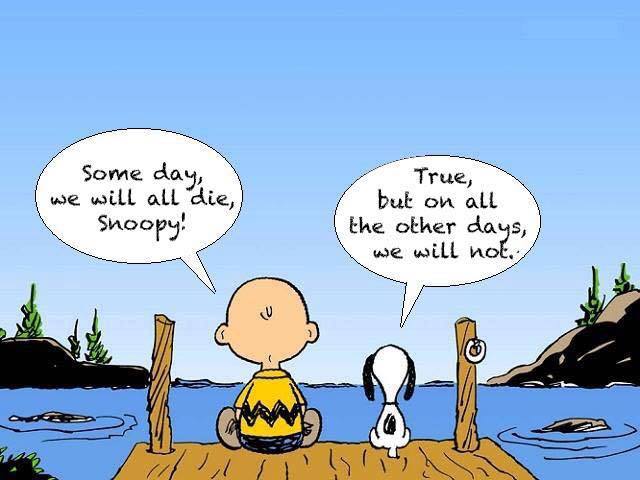
Many of you know that my dad was recently diagnosed with lung cancer.  The months of December and January have been filled with doctor visits and x-rays and worry and prayer. My dad is really lucky because his cancer was found early and could be treated with surgery. He is at home recovering, and while the healing process will take some time, Dad is effectively cancer-free. Gratitude and immense relief have replaced the worry. At some point during these last weeks, I saw this Charlie Brown cartoon on Facebook, and it resonated.  It has probably been around forever, but I have repeated the message to everyone I know lately! Coming from a long line of superstar worriers, I think that what this little message drove home for me is the value of today. This day. This opportunity to live.

Someday, hopefully in the very distant future, my father will leave this earth. But likely, he will not today. Today we are both still here where I can give him a hug and tell him the latest funny thing my daughter said. Today my dad can watch Family Feud on TV and make a joke with Mom and eat Uncle Marty's famous ham on homemade bread. Today we get to live.

As we move out from under the fog of worry of the past few weeks, I endeavor to let go of the worry of what is to come.  I want to be more Snoopy and less Charlie Brown. "All the other days" are flying by, and I don't want to waste a single one.


Thursday, November 19, 2015

Coffee and Conversation

I have always believed that what unites us as human beings is far greater than anything that divides us.  It seems like we are often confronted with our differences and asked to choose between one idea, or belief, or "side" than another.  In this kind of thinking, there are winners and losers; there is acceptance or rejection; there are divides that seem impossible to cross.  Over the past week, I have been thinking about how we are all one people in the world, united by our humanity, and wishing for bridges that could help us reconnect. In a small way, my wish came true last night.

Yesterday evening, our school hosted an event called Coffee and Conversation. This began as a Fed Ex day idea last year (thanks to Euriah Bryant), and it is being carried on this year by Mrs. Jennifer Ball and our students.  At Coffee and Conversation, a diverse group comes together to share a bit of their humanity with each other.  Students from all walks of life and from vastly different peer groups converge on the elementary commons area, and they perform.  Students recited original poetry, played original songs, sang song covers, performed comedy skits, prepared wonderful food, shared their blogs, and exhibited their artwork.  It was a really beautiful thing to see.

As I looked out at the crowd in attendance, I saw looks of love and hope and encouragement and joy on the faces of the audience.  They clapped and cheered, and if they felt like I did, they marveled at the bravery of the kids.  For two hours, we were one people, bound by our hope for these students and their impact on the world.  My heart today is filled with gratitude, as it so often is, for the opportunity to be part of this school community where we are united in service of young people.

Tuesday, October 20, 2015

Time, Choice, and Good Books

Two of the best things that ever happened to my life as a teacher came right at the start of my career. The first was reading a book called In the Middle by Nancie Atwell.  By some stroke of luck, as an undergrad I landed in a class for writing teachers at USI with this book at our text.  To be honest, I do not remember a thing the professor said in class, but I treasure my well-worn copy of In the Middle. The book describes Atwell's approach to teaching reading and writing to middle school students. Her methods are rooted in deep respect for children and a belief in the power of two things:  time and choice.  As their teacher, she facilitated, modeled, encouraged, and marveled at what they created.  

The second awesome thing happened less than a year after reading Atwell's book.  I began my career teaching Spanish and English at Heritage Hills High School, and I got to work alongside a wonderful teacher, Jacquie Sabelhaus.  She taught me many things, but perhaps the most important was that I needed to read the books that my students were reading.  Jacquie said we have to be experts on young adult fiction and nonfiction--to read it voraciously and to use this knowledge to hook kids on reading, too.  The great news is that young adult literature is really, really good.  In addition to being great stories, they are usually quick reads, which is important to teachers already struggling to keep up with demands on their time.  

Jacquie's lesson hit home again this year as I have watched our teachers so diligently implementing the Calkins Units of Study for Reading.  Having firsthand knowledge of the books that students are reading is a bridge to engaging them in deep, meaningful conversations.  Knowing authors, titles, genres and having an ever-growing list of "hook 'em books" is priceless when kids get stuck or fake read or tell you they hate reading.  Kids do not hate reading.  They just have not found the right book yet.  Matching readers to text is so much more than finding a book on the right "level". It is about finding books that give kids a way to transcend their own circumstances, finding books that inspire hope, and finding books that show kids they are not alone.  When we find those books for kids and see the light in their eyes, it is the best feeling in the world. Those are the moments when we remember why we love this work so much.  

There are so many resources online to help find these books, and we are extremely fortunate to have tons of them in the PC library.  The Perry County Public Library has an amazing children and young adult collection as well.  If you are interested in reading more from Nancie Atwell about time, choice, and good books, she wrote a short blog recently for The Washington Post.  You can access it here. http://wapo.st/1b6M9Ce

Wednesday, September 30, 2015

September 30th

September 30th will always be a tough day for our family.  On that date in 2013, my sister's husband died of a massive heart attack.  He was 49 years old.  Some of you know my sister, Tammy.  Like most of our family, she is a school person. At the time of Jim's death, Tammy was principal at McGary Middle School in Evansville, Indiana.  Her four kids were ages 23, 20, 13 and 6.  As Tammy said just the other day in a gross understatement, "It sucks."

And it does.  But with humor and grace and toughness and an impressive repertoire of swear words, my sister keeps moving forward.  She just gets up every single day and keeps going, even when all she wants to do is hide inside Jim's oversized Packers jersey and bury her head under the pillow.  Watching Tammy navigate this grief, I have learned so much about the kind of person I want to be, and I have also learned something important about leadership.  In remembrance of Jim and in honor of my sister's strength, I wanted to write about it today.

Here's the thing.  Tammy has not survived by denying the pain or acting like everything is okay.  She has talked about it and written about it and let people in.  Not long after Jim's death, in Tammy's weekly newsletter to her teachers, she wrote about how she was feeling and helped the staff understand what she needed from them and what they could expect from her.  She was real with them.  She let them see her at her weakest point, and what guts and strength it took.

For me, the lesson here is that it is okay to let those you lead see who you are--to let them see your heart.  It can bridge divides and build community and remind us that we are all human.  For teachers, sharing your heart with students is just as powerful.  Our students need us to be strong and steady for them, but strength and emotion are not mutually exclusive.  Showing students how we manage our own emotions and find ways to keep moving forward is a powerful model for their own lives.

So today, I will share with you that I am sad about my brother-in-law, Jim Dexter, even though it is hard and scary to share something so personal.  Today, my heart and mind are with Tammy, Elizabeth, Everett, Jordan and Jake.  My thoughts are with Jim's mother and his brothers and sisters, who remind me so much of our own family.  Today, my parents, my brother and I will all call Tammy and check on her, and we will swallow the lump in our throats and try not to cry.  Like my sweet, sassy, strong sister, Tammy LaGrange Dexter, we will keep moving forward. That's what she taught us to do.


Thursday, September 24, 2015

What Will Your Verse Be?

My friend, Jacquie, once told me that she was not talking to me again until I had watched the movie, Moulin Rouge.  Convinced that no one should walk the earth without having seen this film, she hounded me until I watched it, and I became a believer.  That is just how I feel about the movie Dead Poet's Society. It combines several things I love:  teachers, students, poetry, and Robin Williams.  When I am feeling discouraged and allow cynicism to creep in, this movie is medicine.  To steal a line from the script, it fills my soul.

There are all of these moments in the film where Mr. Keating, played by Robin Williams, builds a relationship with his students and inspires them to risk failure and to dare greatly. My fellow Dead Poet people will instantly connect when reminded of the opening scene in Keating's English class. As the high school boys gaze at old photographs of students from long ago, Keating reminds them how quickly time passes.  He whispers, "Carpe diem. Seize the day, boys. Make your lives extraordinary." (I just got cold chills writing that, but then we established last week that I have nerdish tendencies.) From the very first day of class, he finds a way to make his message relevant to kids' lives. 

In the film, Keating uses poetry and words to connect with his students--to push them to be brave, to swim against the stream, and to find their voice.  In our school, I see teachers doing this for their students every day in diverse ways.  I was in a classroom today, and on the door the teacher had posted a letter to her students.  "I trust you," it said.  "I believe in you..."  And the teacher's actions matched her words--she interacted with students lovingly and respectfully, and they returned that respect. It was something to see.  The same thing happened in movie-land with Mr. Keating.  He listened to his students, and he challenged them to be their best selves.  Keating's lines from the movie that follow (my favorites) provide a challenge for us all.

"We don't read and write poetry because it's cute. We read and write poetry because we are members of the human race. And the human race is filled with passion. Medicine, law, business, engineering-- these are noble pursuits and necessary to sustain life. But poetry, beauty, romance, love... these are what we stay alive for! To quote from Whitman, 'O me! O life!... of the questions of these recurring; of the endless trains of the faithless... of cities filled with the foolish; what good amid these, O me, O life?' Answer. That you are here - that life exists, and identity; that the powerful play goes on and you may contribute a verse. That the powerful play goes on and you may contribute a verse.

"What will your verse be?"


Thursday, September 17, 2015

We Love Lucy

Warning:  geeky, gushing English/reading teacher talk follows. #hopeyoustillreadit

It is safe to say that Perry Central Elementary could form a fan club for Lucy Calkins and her work in teaching students to read and write. We are #ruos and #tcrwp stalkers on Twitter.  We call her by her first name as if we are old friends.  The thing about Lucy is that her work does not just teach kids to be literate--that is a drastic oversimplification of what she does.  She treats students as if they are capable of contributing something valuable to the classroom and to the world.  And they do.  In this balanced literacy model, students think deeply about text and about their own writing because they believe that their voices matter.  Perhaps it is because the approach aligns with our philosophy of relationships being the foundation for learning that Lucy Calkins's work has resonated with us. 

Many of our elementary teachers have been implementing the Lucy Calkins Units of Study for Reading since the start of school.  These units are written for K-5, and they pair well with the Units of Study for Writing that she also developed.  The units require a tremendous commitment because they are not cookie-cutter, simple lesson plans with cute, quick activities.  They are robust lessons that teachers are reading and re-reading prior to implementation.  That does not mean teachers check their brains at the door, rather they use the lessons as a guide and springboard for reading and writing in their classrooms.  

It makes me smile to see teachers' Lucy books with dog-eared pages and post-it notes sticking out in all directions and color-coded highlights.  It makes me smile to listen to the questions teachers and students are posing, to see the light in kids' eyes and watch how they lean in as the teacher reads aloud.  It is not that the Units of Study alone are responsible for this--we have built a strong reading curriculum over the years, and we have talented, dedicated teachers who are constantly looking to get better.  That is what these units are helping us to do--become stronger, more thoughtful practitioners.  Beautiful things are happening in classrooms in little Leopold, Indiana, and it is a joy to behold.  

The following are some links to RUOS resources in case you are not from PC and happen to read this blog.  If you are already using them, you might find something to keep pushing you forward. If you have been reluctant to try the units or worrying about how to "fit it all in", then maybe these resources will help you take the leap.  

Videos by Lucy Calkins for each grade level:  http://readingandwritingproject.org/resources/units-of-study-in-reading

Videos and samples of student work (reading and writing):  http://readingandwritingproject.org/resources/student-work

Book Lists:  http://readingandwritingproject.org/resources/book-lists


Friday, September 11, 2015

School Spirit

Last week, we entered a competition about school spirit, and our students and staff did a great job of demonstrating it last Friday with the sea of green attire and hallway decorations.  The whole thing got me thinking about school spirit and how it is part of what makes Perry Central a special place.

The Perry Central Commodores grew from the consolidation of many small schools that had to give up a bit of their identity to become part of something greater.  It took courage and vision to bring together this school community back then, and we are grateful for those who led the charge.  We take pride in Perry Central, and most of us who have grown up amid the rolling hills of rural Perry County (or landed here by some stroke of luck) identify ourselves by our school.  We are Commodores; we bleed green.  One needs only attend a Perry Central athletic event to see this in action.  No matter how good or bad our team, our community shows up to support it.  That is pretty special.  

That said, true school spirit, to me, is a balance of pride and humility.  Sure, we want to win, and we celebrate when we do.  But what makes me really proud is when I see our students and community stand and clap during the other team's starting line up.  What makes me proud is when we stand and applaud for an opposing team's injured player as she leaves the court. What makes me proud is when our students cheer for their team, rather than against the other team. That is school spirit, but more, it is an outward demonstration of who we want to be--the kind of people who treat others right, regardless of whether that kindness is returned.  While we have all seen a moment here and there where we failed in this endeavor, the vast majority of the time, Commodore Spirit shines as an outward symbol of who we are at heart.  For all my fellow Commodores out there, thanks for being part of that tradition.  And as Mr. Edd Ransom would say, "Go Big Green!"  


Friday, September 4, 2015

More Twitterverse Talk

The Perry Central school community is getting really good at this Twitter thing!  It is so exciting!  Twitter and Facebook are becoming vehicles for connection and learning and praise and building positive relationships.  I wanted to take a moment in this blog to say thanks to all who have jumped on board and to share with you some highlights of the land of social media from just this week (in case you missed it) and how they served different purposes.

Twitter/Facebook to Build Community
There is nothing that means more to me than when someone says something kind about one of my children or shares a story about something they said or did.  Those of us who work at school are fortunate to get to see our kids from time to time and to interact with their teachers, but many parents seldom get that opportunity.  Social media is a channel for sharing kids' school lives with their families.  For you Tweeters out there, if you have your Twitter account connected to Facebook, it would be awesome if you would share the Facebook post to the Perry Central Facebook page.  Many of our parents are on FB but not Twitter, yet.  Here are some examples from this week.


Twitter to Connect with Educators
Using hashtags is a great way to connect with other educators who are working on the same things. Our K-5 teachers are implementing a new reading approach, using Lucy Calkins's Reading Units of Study, which are awesome!  The #ruos hashtag connects them with other teachers across the country who are also using the units.  We have discovered related chats and a new RUOS Facebook page by reading the hashtag.


Kris Walsh connected with the Project Lead the Way community with this Tweet.


Twitter and Facebook to Spread Your Message
Others will build their perception of you and our school based on your tweets.  I loved this tweet from Perry Central volleyball this week...what a powerful message!


Twitter for Learning
It is amazing how much great learning can spring from a quick scroll through the Twitter feed.  Share your finds with your PLN!  Phil and Jody shared these resources this week.


So thanks to all of you for jumping on board!  We are planning social media help sessions next week on Wednesday and Thursday. We'll email the details soon.  Have a great Labor Day weekend!


Wednesday, August 26, 2015

Let the Light In

I love our school's annual themes, but I have to admit that last year's "Be Brave" is my all-time favorite (so far).  I think it is because I see so many acts of bravery every day at Perry Central.  Maybe part of it is also the Sara Bareilles song that became an anthem for the year.   I am a sucker for good lyrics, and the following lines from the song give me cold chills every single time I hear them.

Everybody's been there, everybody's been stared down by the enemy,
Fallen for the fear and done some disappearing,
Bowed down to the mighty.
Don't run; just stop holding your tongue.

Maybe there's a way out of the cage where you live;
Maybe one of these days, you can let the light in.
Show me...how big your brave is.

Yep, cold chills right now.  These lines resonate because for some kids, we can almost see the bars of their cages.  Their cages are made of poverty or violent homes or sexual abuse or hunger or loneliness or obesity or simply not fitting in with their peers.  These cages should make learning, which is our fundamental purpose as a school, a long shot.  Yet learn they do.  Our kids amaze us all the time.  

Just this morning I saw a student (a struggling reader) raise his hand to answer the teacher's question about what a character's actions could tell us about theme.  The young man started out a bit tentatively; then the teacher gave him a nod and smile, and he said the smartest thing.  He said the character showed that it is important to never give up hope.  And he was right about the theme, and he understood the message.  The teacher has created a classroom culture that shines light and opens cages.  And out comes bravery!  I was lucky to see one act of bravery among the hundreds that surely happened today.  Please forgive my sappiness, but the staff and students here are, quite simply, an inspiration.  That gives me cold chills, too.  I am going to have to get a sweater.


Wednesday, August 19, 2015

What's All the Fuss About Twitter?

At the risk of seeming like a George Couros groupie, I feel compelled to blog once again about something he said on our first day of school.  After showing us the Perry Central hashtag, #pccsk12, and suggesting that we tweet to it often, Mr. Couros said this.  "If you don't know what any of this means (Twitter, tweeting, hashtags) or what I am talking about, you are in danger of becoming illiterate in the world today."

That is a bold statement, and it really made me think.  Literacy is an important word to me--it conjures the ideas of freedom and opportunity and connection and relationships.  I think of literacy as more of a basic human right than a skill.  Without it, how can one survive?  And I think about vehicles for literacy and how those have changed over time--from stone tablets to paper to typewriters to little handheld computers we can slip in our pockets.  What are the vehicles for literacy in 2015?

For our students, a big part of literacy is sharing their reading, writing, videos, and snapshots through a medium that reaches the audience most important to them--their peers.  And for many of them, that means Twitter or Instagram, or (heaven forbid) Snapchat.  If I were not an educator or a parent, it is possible that I could remain literate in 2015 without ever learning how to navigate Twitter.  I could continue to roll my eyes, pronounce it "Tweeter" and log onto Facebook like a normal 40-something.  But I am an educator and a parent, and that means I have to follow the kids where they go, lest I lose wonderful, meaningful ways to communicate with them.

My dad always said that teachers had to "meet kids where they are and then take them as far as possible."  As scary as it seems, the place where kids are is in the land of social media.  And we must meet them there in order to take them as far as they can go.  Let's jump in together.  Come on...it'll be fun.


Monday, August 10, 2015

George Couros's Challenge

This is my first ever blog post, and I am scared to death.  To me, writing is personal, and putting it out on the web seems so permanent.  What I think today is likely to change by tomorrow, but today I put it in print, for the love of heaven!  So I am scared, just so you know.  But I am going to do it anyway because last Monday, George Couros issued me a challenge.  "If the only reason you are using the Internet is for research, you are missing the point," he said.  "If you want your school embracing these ideas, you have to model it," he said.  Okay fine, George, if you say so.  Here I go.

Last Monday was what we call "teacher day" -- it was the first day back to school for teachers, and students came back the next day.  We typically allow teachers a lot of time in their classrooms on this day, but this year we brought in a speaker--George Couros--to kick off our year.  I was nervous that people would be upset about losing that precious time in their classrooms and hesitant to hear the message, but I underestimated Couros's charisma!  And his message was pretty awesome, too.  By day's end, we had laughed and cried and learned, and a lot of people entered the world of Twitter.  We learned about the necessity to embrace technology as a powerful tool for learning, but we also heard that all learning grows from the foundation of positive relationships with students and with each other.

Seven days have passed since George's visit, and I am worried the message has started to fade.  There is always so much to do!  How can we tweet to the hashtag (#pccsk12 by the way) and greet students at the door each morning and prepare the lessons and grade the papers and fix supper and make it to the church meeting and, and, and...?  I do not have the answer to that.  Frankly, I am amazed at how much teachers get done every day of their lives with smiles and humor and grace.  The only thing I know to do is set a goal.  Each morning when I take my daughter to her classroom, I am going to greet students with a smile.  Once a day, I am going to tweet to the hashtag, and once a week, I am going to write this blog.  There, I said it.  In writing.  And I am still scared, but also motivated and excited.

I wonder which of George's messages stuck with others.  Are they greeting students at the door each day with a smile or hug or high five?  Are they developing a PLN on Twitter?  Have they used video to show what kids are learning?  My challenge to all of us is to just try something--start somewhere. Let's live out our theme for the year...Relate. Innovate. Create.  And as always, be brave.